

Could We Attempt Time Travel Using 21st Century Technologies In Our Lifetime?
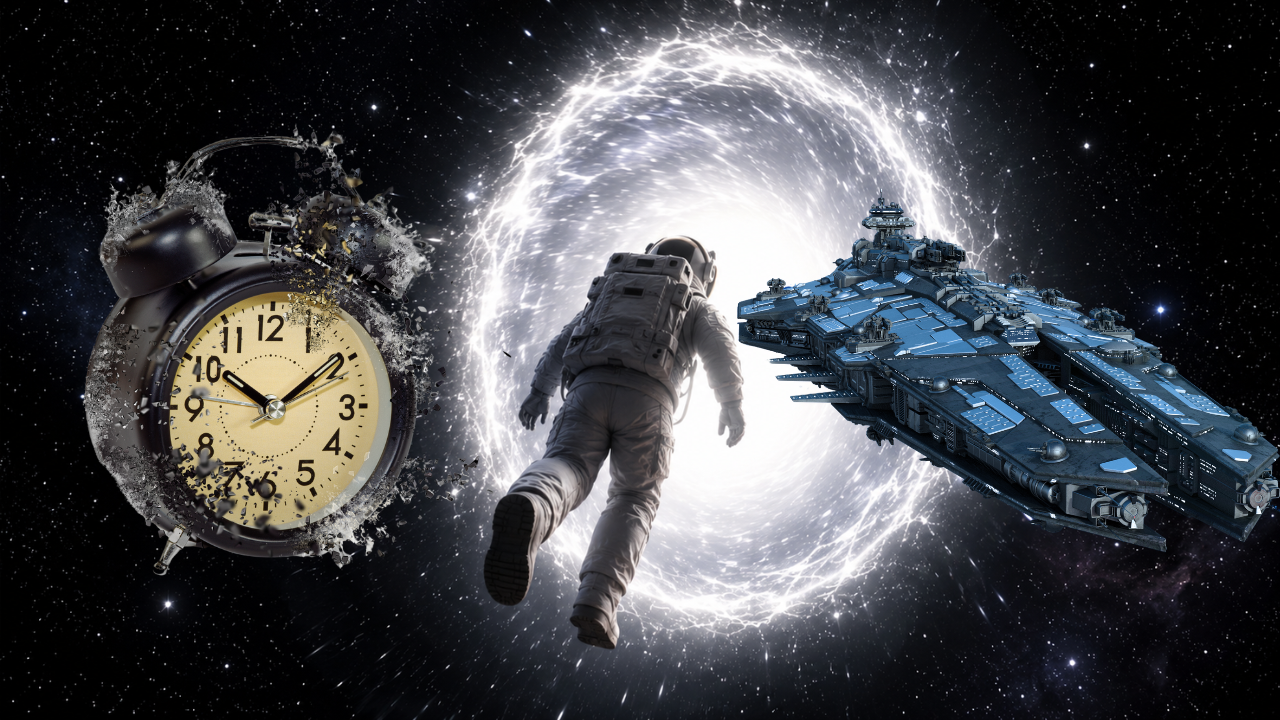
Imagine having the ability to travel through time, either to the future or to the past. While this idea may appear practically impossible today, Scientists have proven that it may become possible someday in the future. But could that some day happen in our lifetime? We are about to explore the possibility of our generation to advance enough and build sophisticated time travel technology that could enable us to travel either to the future or travel back in time.
How Could We Even Attempt to Time Travel?
NASA has already confirmed that time travel to the future is scientifically possible today. The agency used Albert Einstein’s theory of relativity to discover that the faster you move or the more powerful the gravity you experience, the slower time moves for you relative to a stationary observer.
One of the proofs of time travel we have today is astronauts aboard the International Space Station. They move at approximately 5 miles per second. Hence, this speed makes them age slightly more slowly than humans on Earth. For every 1,000 days they spend in space, they jump approximately 0.027 seconds into the future relative to people on Earth, the stationary observers.
While this example proves that time travel is already possible, it does not clearly show that we can now travel significantly into the future or into the past. So, can we attempt an advanced level of time travel in our lifetime?
For humans to travel into the future, physics could actually make it possible. However, traveling back will be quite difficult for our kind even in the near future. So we are going to explore how our generation could practically attempt time travel, slow and steady, before 2100.
What Could We Do To Practically Travel In Time In Our Lifetime?
Most people think that time travel in real life is just like humans do in science fiction movie, whereby a person will enter an electrifying portal and come out of a distant future or past. In reality, time travel is more than that. We are going to explore practical ways we could achieve time travel before 2100.
The GPS proof (2030s)
The first idea is using GPS, which is already happening. Your phone corrects for time dilation every single day. So how does it work? GPS satellites tick 38 microseconds faster because they sit higher in Earth’s gravity well. This fascinating discovery alone proves that Einstein was right.
If we could achieve this today, we would likely do more in the next few years. By 2035, precision atomic clocks flown to high altitude could let a single individual personally measure that they aged slightly less than someone on the ground. That’s time travel in the strictest physical sense, and it’s three rocket rides away. How exciting could that be?
Cryo-suspension (2030s–2040s)
Scientists are already able to use therapeutic hypothermia to slow metabolism for heart surgery. However, the remaining problem is ice crystal damage at the cellular level. But the good news is that nanoparticle cryo-protectants are closing that gap fast. We should be expecting the first decade-long human suspension trial to happen before 2045.
While this concept doesn’t allow you to outrun time, it will still allow you to simply check out of it and check back in later. No physics violation required. Just very cold chemistry.
Near-lightspeed ion drive (2050s–2060s)
At our current level of solving engineering problems, we can comfortably say that fusion and antimatter drives are not science fiction. At this point, we can say they are just engineering problems. A ship hitting 30% light speed gives you real, measurable time compression.
At 90%, you return from a 10-year mission 23 years forward. Now imagine looking 13 years younger than your current self, just by embarking on a mission. This is serious technology. When you combine this fast technology with cryo, you have the cryo-relativistic ark.
This powerful spaceship could serve as a vessel where passengers sleep at 0.9999c, age 10 years, and wake up 700 years in humanity’s future. That ship could launch before 2100. It would be the most sophisticated spaceship our species ever built.
Can We Possibly Travel Back In Time In Our Lifetime?
Science has proven that traveling back in time is more difficult. However, it is not totally impossible. Now, let’s explore technologies that would enable us to travel back in time in our lifetime.
Retrocausal quantum signaling (2050s)
Scientists revealed that we could use this futuristic technology to attempt to travel whispering back in time in the 2050s. Wheeler’s delayed-choice experiments already prove that a photon’s past behaviour changes depending on what a future detector does.
Science has already proven it, and it is published as an experimental result. By 2055, scaled entanglement networks could test whether a causal signal can provably precede its own emission. We may not travel backward, but we might whisper backward in time using this technology.
Micro Alcubierre bubble (2060s)
In 2021, physicist Harold White found a configuration of the Alcubierre warp metric that doesn’t need exotic negative energy. It just needs a very precise positive energy density. By 2060, a lab might compress a region of space at a sub-atomic scale. No one travels anywhere, but you’ve bent spacetime in a controlled environment. That’s the first stair on a very long staircase.
CTC cosmological scan (2070s)
Science has shown that a closed time-like curve is a loop in spacetime. This could serve as a path where your future self re-enters your past. General relativity permits them near rotating black holes. Hence, by 2075, next-generation gravitational wave observatories could theoretically detect a CTC signature within a few light-years. However, finding one doesn’t let mean we have advanced enough to use it. But it tells us the door exists.
Quantum vacuum temporal imprint (2090s)
This idea is one of the boldest and most haunting ideas of traveling back in time. Keep in mind that every quantum event leaves a trace in the vacuum state of the universe. Hence, an AGI-powered quantum computer with enough resolution could theoretically reconstruct past quantum configurations.
But this does not physically allow traveling backward. However, it could enable reading the past with perfect fidelity. Not visiting 1920. More like watching it in 4D with atomic precision. The universe is its own black box recorder.
In summary, it is important to note that traveling to the future could be much easier for our generation than traveling backward in time. But based on what we have accomplished so far, do you think our kind will attempt to travel in time before 2100?