


What Humans Actually Saw Orbiting the Moon During Artemis II
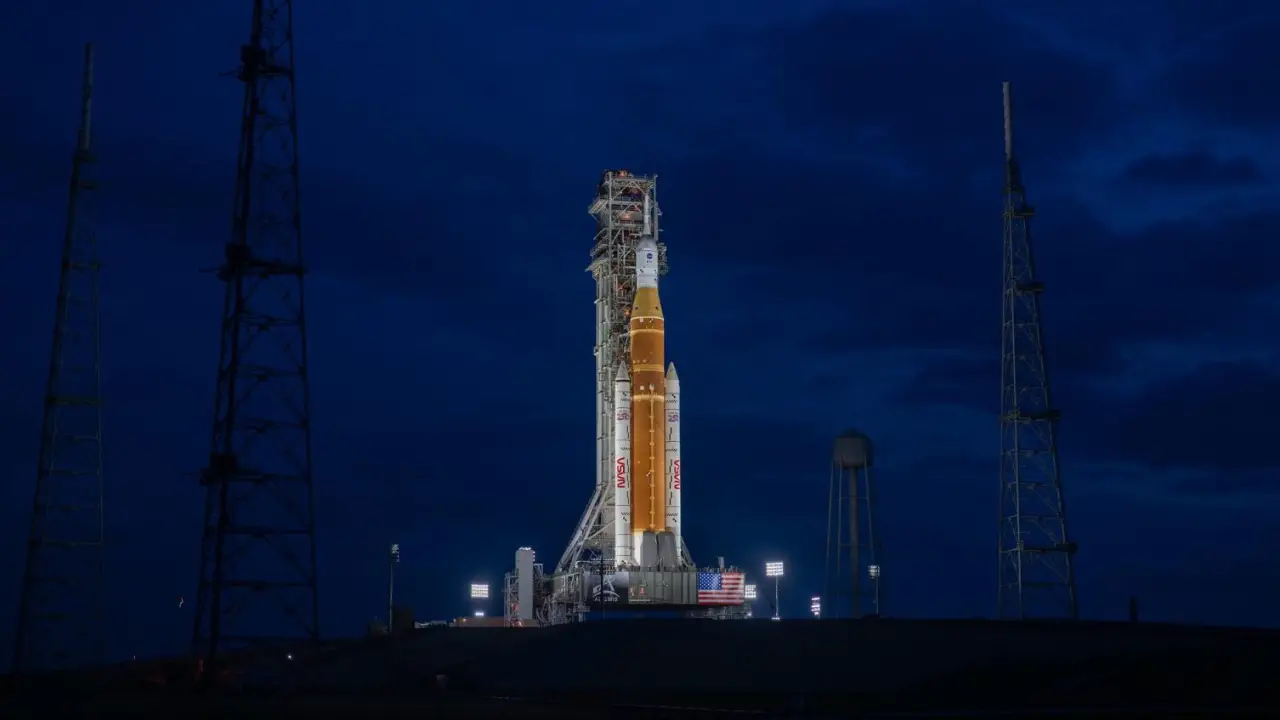
For 54 years, the Moon watched us from a distance. We sent probes, orbiters, and rovers to study its surface — but no human being had looked back at Earth from beyond low orbit since the last Apollo astronaut splashed down in December 1972. However, that long silence ended on April 1, 2026, when NASA’s Artemis II mission roared off the launchpad at Kennedy Space Center and sent four astronauts on the most important human spaceflight of the 21st century.
What followed over the next ten days was nothing short of extraordinary. A record broken. History made. And a set of images so breathtaking that they stopped the world.
This is the story of what those four astronauts actually saw when they flew around the Moon — and why what they witnessed matters not just for space exploration, but for the future of all humanity.
The Crew That Made History
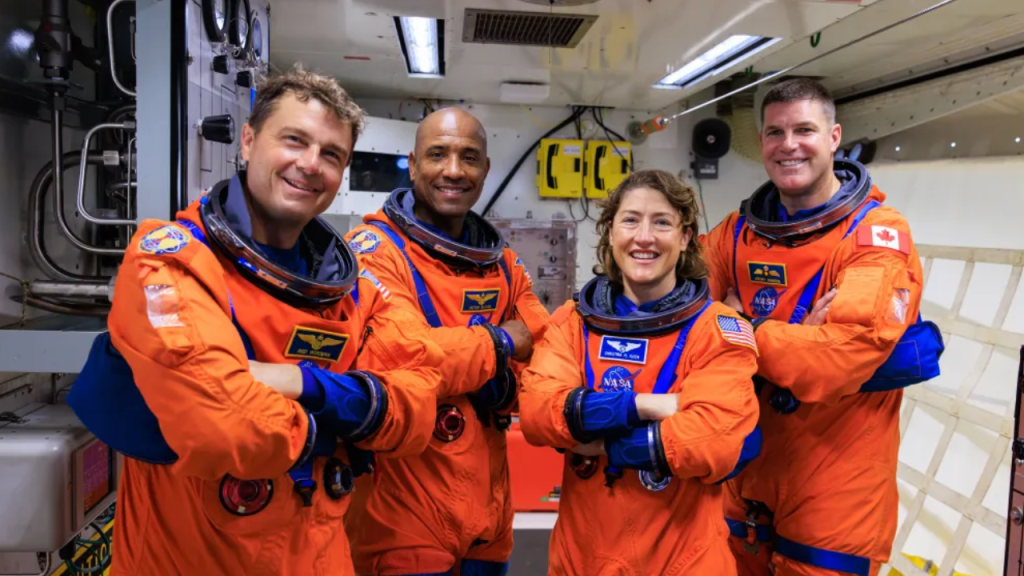
Before we talk about what they saw, we need to talk about who they were — because the crew of Artemis II was as historic as the mission itself.
Commander Reid Wiseman led the four-person team aboard the Orion spacecraft, which the crew affectionately named Integrity. Alongside him flew Victor Glover, Christina Koch, and Canadian Space Agency astronaut Jeremy Hansen.
Each of them shattered a barrier that had stood since the Apollo era:
- Victor Glover became the first person of color to travel beyond low Earth orbit and around the Moon.
- Christina Koch became the first woman in history to make the journey.
- Jeremy Hansen became the first non-American citizen to fly around the Moon.
- Reid Wiseman became the oldest person ever to travel beyond Earth’s orbit.
In a single mission, NASA didn’t just repeat history — it rewrote it. And the world noticed. The mission sparked a term that swept across social media and headlines globally: “Moon joy.”
Launch Day: April 1, 2026
At 6:35 p.m. EDT on April 1, NASA’s Space Launch System (SLS) rocket — the most powerful rocket America has built since the Saturn V of the Apollo era — ignited its engines at Launch Pad 39B with a staggering 8.8 million pounds of thrust. The ground shook. The sky lit up. And for the first time in over five decades, humans were on their way to the Moon.
After reaching space, the Orion spacecraft deployed its four solar array wings to draw power from the Sun, while the crew and ground engineers immediately began a thorough checkout of all spacecraft systems. The first day was spent in high Earth orbit, testing and confirming that everything aboard Integrity was performing exactly as designed.
On the second day, April 2, everything changed. Orion’s main service module engine fired for approximately six minutes in a manoeuvre called the Translunar Injection burn — and with that single firing, the spacecraft broke free of Earth’s gravitational hold and began its journey toward the Moon.
“Today, for the first time since Apollo 17 in 1972, humans have departed Earth orbit,” said Lori Glaze, acting associate administrator for NASA’s Exploration Systems Development Mission Directorate, as the announcement sent Mission Control into celebration.
Shortly after the burn, the crew captured one of the most striking images of the early mission: a photograph of Earth from Orion’s window, showing the planet glowing against the black void of space — with two visible auroras shimmering at the top and bottom of the frame, and the delicate glow of zodiacal light visible as Earth eclipsed the Sun. Venus appeared as a bright dot in the lower right corner. It was the kind of image that reminds you just how alone — and how beautiful — our planet really is.
Crossing Into the Lunar Sphere of Influence
By Day 5 of the mission, on the morning of April 6, the Orion spacecraft crossed a threshold that no human crew had reached in more than half a century: the lunar sphere of influence — the point in space where the Moon’s gravitational pull becomes stronger than Earth’s.
The crew was no longer in Earth’s domain. They belonged to the Moon.
What followed in the hours ahead would be the centrepiece of the entire mission — the lunar flyby — and the moment that the whole world had been waiting for.
The Flyby: Seven Hours Above the Moon’s Surface
On April 6, the Orion spacecraft made its closest approach to the Moon, flying within 4,067 miles (6,545 kilometres) of the lunar surface. At that altitude, the crew had an extraordinary and rare view: the Moon appeared roughly the size of a basketball held at arm’s length — close enough to see its ancient craters, mountains, and dark volcanic plains in vivid detail, but distant enough to see the entire lunar disk at once.
For nearly seven hours, the crew observed the Moon’s surface and captured photographs during their science observation period, transmitting as many images back to Earth as the spacecraft’s communications systems would allow.
But the most remarkable aspect of the flyby was not the near side of the Moon — the familiar face we all see on a clear night. It was the far side.
A View No Human Had Ever Seen Before
The far side of the Moon is a place of deep mystery. It never faces Earth. From the surface of our planet — no matter where you stand, no matter how powerful your telescope — you will never see it. Even the Apollo astronauts, heroes all, could not fully observe the far side because of the paths and timing of their missions.
Artemis II changed that.
As the Orion spacecraft swept around the far side of the Moon during the blackout period — when radio signals were blocked by the Moon itself, and all communication with Mission Control was cut — the four astronauts became the first humans in history to clearly observe features of the lunar far side from a crewed spacecraft.
“From all of us, it’s a privilege to witness you carrying the fire past our farthest reach. Thank you. Godspeed,” capsule communicator Jenni Gibbons radioed to the crew just before they crossed into radio silence.
Among the far-side features the crew observed and photographed were:
- The Orientale Basin — one of the youngest and most well-preserved large impact basins on the Moon, perched on the edge of the lunar far side. This was the first time humans had seen it directly with their own eyes.
- The Hertzsprung Basin, an ancient crater visible as two subtle concentric rings, is interrupted by the younger Vavilov crater superimposed over its older structure.
- Chains of secondary craters — lines of indentations caused by debris ejected from the massive Orientale impact billions of years ago.
In a deeply personal moment, the crew named two small craters they discovered near the Orientale Basin: Integrity, after their beloved spacecraft, and Carroll, named by Commander Reid Wiseman in honour of his late wife.
The Earthset: A New Earthrise for a New Generation
Perhaps the single most iconic image to emerge from Artemis II was one that echoed the most famous photograph in the history of space exploration.
In 1968, the crew of Apollo 8 captured Earthrise — a photograph of Earth rising above the Moon’s surface that became one of the most reproduced images of the 20th century and sparked the modern environmental movement. It changed the way humanity saw itself.
On April 6, 2026, the Artemis II crew captured its own version: Earthset.
As the Orion spacecraft passed behind the Moon’s far side, the crew photographed Earth slowly descending below the Moon’s curved limb — the blue and white of our home planet dipping below a stark, airless horizon. In the image, the darkened portion of Earth is experiencing nighttime, while swirling clouds are visible over Australia and the Oceania region on the day side.
It is a photograph that carries the same emotional weight as Earthrise — a reminder of our smallness, our fragility, and the extraordinary miracle of the pale blue dot we call home.
Four Impact Flashes: A Surprise Scientific Discovery
Not everything the crew observed was planned. During their time observing the lunar surface, the astronauts witnessed something that scientists at Mission Control described as “amazing news.”
Commander Wiseman and astronaut Jeremy Hansen each observed asteroid impact flashes on the Moon’s surface — visible glints of light caused by incoming space rocks striking the airless lunar terrain. Wiseman reported seeing two, and Hansen saw two more during the communications blackout period, when the crew was on their own behind the Moon.
“There was a little bit of giddiness,” Wiseman reported when he described the sightings.
The lunar science team at Mission Control erupted. One NASA team was seen “jumping up and down literally” upon hearing the news.
These impact flashes are scientifically invaluable. Because the Moon has no atmosphere to burn up incoming debris the way Earth does, asteroid strikes occur frequently. Studying them helps scientists understand the rate of cosmic bombardment in the inner solar system and piece together how the Moon’s cratered surface has evolved over billions of years. Having human observers capture them in real time — rather than relying on robotic cameras — represents a genuine scientific advancement that robotic missions simply cannot replicate.
Breaking the Ultimate Human Distance Record
There is a moment in every great journey where a line is crossed — a point of no return, a new extreme, a number that rewrites the record books.
For Artemis II, that moment came on April 6 when the Orion spacecraft reached its farthest point from Earth: 252,756 miles (406,771 kilometres).
With that single measurement, the Artemis II crew became the humans who had traveled farther from Earth than any other human beings in history — shattering the previous record set by the crew of Apollo 13 in 1970, who had reached 248,655 miles during their emergency free-return trajectory around the Moon after an explosion crippled their spacecraft.
Apollo 13’s record had stood for 56 years. Artemis II broke it by more than 4,000 miles.
To put that in perspective: at 252,756 miles from Earth, the astronauts were so far away that a radio signal — travelling at the speed of light — took over 1.3 seconds to reach them. When they looked back at Earth, they saw it not as a large globe filling the sky, but as a distant, bright sphere, small enough to be covered by a raised thumb.
The Solar Eclipse from the Moon’s Perspective
During the lunar flyby, the crew was treated to yet another experience that very few humans have ever had: watching a solar eclipse from behind the Moon.
From the Orion spacecraft’s vantage point, the Moon passed between them and the Sun, blocking its light and revealing the solar corona — the Sun’s outer atmosphere — in a way that is invisible from Earth’s surface. Canadian astronaut Jeremy Hansen provided vivid descriptions of the eclipse to Mission Control in Houston, describing the sight with the kind of careful, awed language of a scientist encountering something extraordinary.
Nearby, Venus shone brightly in the frame — a haunting reminder that across the darkness of space, other worlds exist.
The Return Home
After their historic flyby, the crew of Integrity began the long journey back to Earth. On April 10, 2026 — ten days after launch — the Orion spacecraft entered Earth’s atmosphere and splashed down at 5:07 p.m. PDT in the Pacific Ocean, off the coast of San Diego, California.
U.S. Navy recovery teams were waiting. The capsule was secured, the hatch was opened, and one by one, Reid Wiseman, Victor Glover, Christina Koch, and Jeremy Hansen were hoisted into waiting helicopters — returning to a planet that had watched their journey with the whole world’s breath held.
NASA Administrator Jared Isaacman captured the moment with words that will likely be remembered for a long time:
“Artemis II demonstrated extraordinary skill, courage, and dedication as the crew pushed Orion, SLS, and human exploration farther than ever before. As the first astronauts to fly this rocket and spacecraft, the crew accepted significant risk in service of the knowledge gained and the future we are determined to build.”
What Comes Next: The Road Back to the Lunar Surface
Artemis II was never intended to land on the Moon. It was a test — a critical, irreplaceable dress rehearsal to validate the Orion spacecraft’s systems, crew procedures, and deep space performance before the real landings begin.
And now, those landings are next.
Artemis III, currently planned for 2027, will see the Orion spacecraft rendezvous with a commercial lunar lander in Earth orbit to test integrated operations. Artemis IV, targeted for early 2028, will be the first actual crewed landing on the Moon since Apollo 17 in 1972 — the mission that will, at long last, put human boots back on the lunar surface.
When that happens, two astronauts will descend to the surface, conduct scientific work, and then ascend back to Orion waiting in lunar orbit. It will be the fulfilment of a dream that has been half a century in the making.
And it will only be the beginning. NASA’s long-term vision — laid out in the Artemis program roadmap — calls for a permanent lunar base, a sustained human presence on the Moon, and ultimately, the technologies and experience needed to send the first humans to Mars.
The Moon is not a destination. It is a launchpad.
Why Artemis II Matters for All of Us
It would be easy to look at Artemis II and see it as an American story — a NASA story. But it is much bigger than that.
The Artemis program includes contributions from space agencies across Europe, Canada, Japan, and beyond. The Orion spacecraft’s European Service Module — built by the European Space Agency — powered the mission. A Canadian astronaut flew it. And the Artemis Accords, signed by dozens of nations, have established a framework for international cooperation in the exploration and use of the Moon.
For those of us on this side of the world — in Africa, in Nigeria, in communities still dreaming of what the stars might hold — Artemis II is a reminder that the universe does not belong to any one nation. The future of space exploration belongs to humanity. And humanity’s future, whatever it holds, will be shaped in no small part by what happens on that grey and ancient surface a quarter of a million miles from Earth.
The Moon is calling. And this time, we are not going to stop.