

Scientists Just Found a Way to Turn Plastic Trash Into Clean Hydrogen Fuel
Most of the plastic trash we throw away never actually goes anywhere. It sits in a landfill for decades, or it gets burned and adds more carbon to an atmosphere that already has too much. That has been the story of plastic waste for as long as recycling has existed as an idea.
Now a team of engineers from UCLA and Ewha Womans University in South Korea says they have found a way to change that story. They built a process that takes ordinary mixed plastic and converts it directly into clean hydrogen fuel, without the sorting step that makes recycling so expensive and without releasing the carbon back into the air.
The work was published in Proceedings of the National Academy of Sciences, and it tackles two problems that usually get treated as separate. One is a planet full of plastic with nowhere good to put it. The other is the world’s need for a clean, scalable source of hydrogen to help power the shift away from fossil fuels.
Why Recycling Plastic Trash Has Never Really Worked
Across the globe, humans only recycle about 9 percent of plastic waste. Data show that roughly 79 percent ends up in landfills, and humans burn another 12 percent, which releases carbon dioxide into the air. The main reason recycling has stayed stuck at such a low number is sorting. Different plastics have different chemical structures, so most recycling systems need each type separated before it can be processed. That step takes time, money, and labor, and a lot of plastic never makes it through.
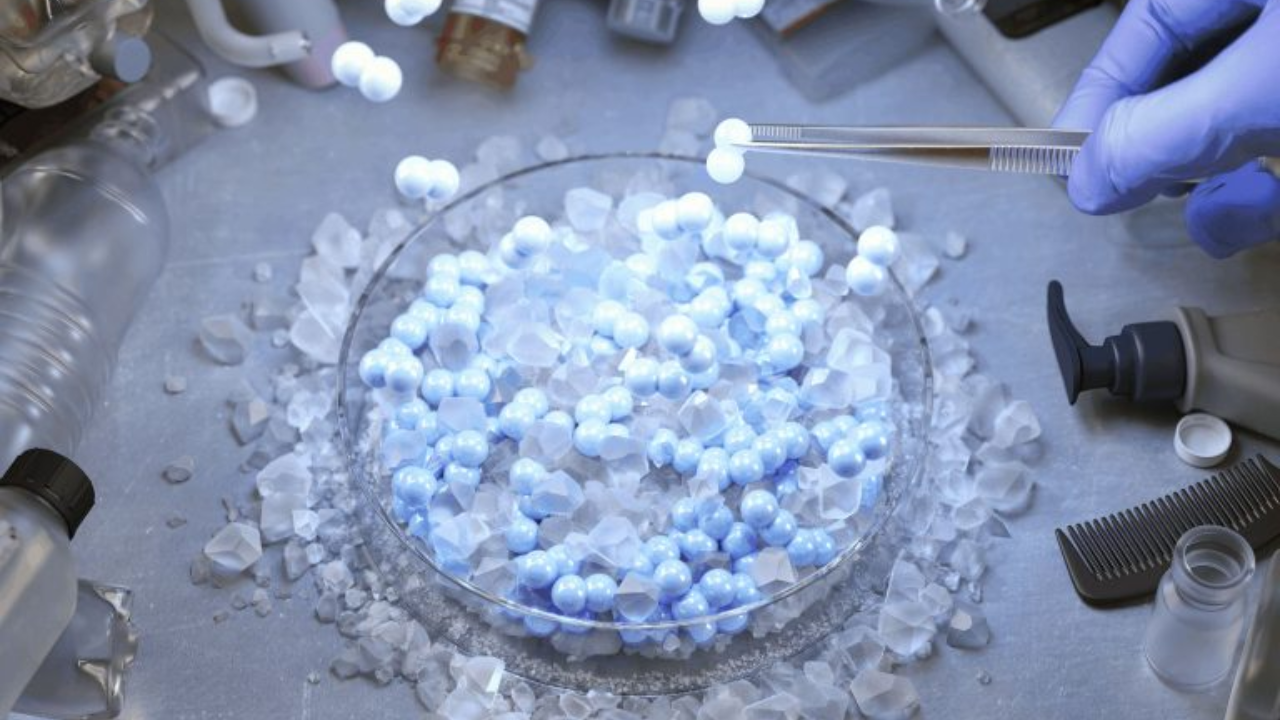
The new process skips that requirement entirely. It works on a mix of the three most common plastics in the world, PET, polyethylene, and polypropylene, the materials found in water bottles, shopping bags, and car parts. All three can go into the same reactor together, unsorted, and come out the other side as hydrogen gas that is more than 90 percent pure.
How the Process Actually Works
Scientists refer to this method as alkaline thermal treatment. Heated sodium hydroxide reacts with the plastic and breaks it down, releasing hydrogen in the process. It also runs at much lower temperatures than the gasification methods currently used in industry, somewhere between 300 and 400 degrees Celsius cooler.
Ah Hyung Alissa Park, one of the lead researchers and the dean of UCLA Samueli, explained why this matters so much. She said the team is “solving two urgent global problems at the same time,” pointing to the fact that plastic waste keeps piling up while clean hydrogen remains essential for cutting emissions. Her point was that this single process addresses both issues at once, in a way that could actually scale up.
The method did not start out as a plastic solution. Park and her co-author, Woo Jae Kim of Ewha Womans University, originally built it to turn biomass, like seaweed, into hydrogen without releasing extra carbon. They later adapted the same chemistry for plastic waste, and PET responded especially well, producing strong yields of hydrogen at those lower temperatures.
The Plastics That Would Not Cooperate
Polyethylene and polypropylene were a different story. Their molecules are made almost entirely of carbon and hydrogen bonds that do not react easily with sodium hydroxide, so they produced far less hydrogen at first.
To fix that, the researchers added a short pretreatment step. Before the main reaction, they briefly heat the plastic in air. This adds oxygen-based chemical groups along the plastic’s molecular chains, which gives the sodium hydroxide something to actually react with. Once that step was added, all three plastics broke down efficiently and produced hydrogen at similar rates.
Where the Carbon Goes Instead of the Air
This might be the most important part. Instead of releasing carbon dioxide, the reaction locks the carbon into a solid. The sodium hydroxide grabs the carbon and turns it into solid sodium carbonate. After testing, the researchers found that more than 75 percent of the plastic’s original carbon stayed locked in that solid form or in liquid residue. Less than 13 percent ever reached the gas phase, and almost none of it escaped into the atmosphere as carbon dioxide.
That sodium carbonate is not just leftover waste either. It can go through a simple recovery process and become calcium carbonate, a mineral already used across construction and manufacturing. So the carbon that would have polluted the air instead becomes raw material for other industries.
Why This Beats Earlier Attempts
Other low-temperature methods for pulling hydrogen out of plastic have run into limits. Solar-powered and electrochemical methods only work on plastics that already contain oxygen, like PET, which rules out polyethylene and polypropylene even though both are everywhere in the waste stream. Traditional high-temperature gasification can handle mixed, unsorted plastic, but it produces heavy carbon emissions in the process.
This new method appears to be the first one that clears all three hurdles together. It handles unsorted mixed plastic, runs at far lower temperatures, and keeps the carbon locked away instead of letting it escape.
Woo Jae Kim summed up the bigger opportunity this creates. He said that by cutting the sorting costs and complexity that have blocked commercialization, this technology could grow into a core part of both the hydrogen economy and the circular economy.
What Still Has to Happen
None of this means plastic-to-hydrogen plants are opening anytime soon. The researchers are upfront that there is more work ahead. They still need to improve how efficiently the process runs and prove that it actually makes economic sense at a real industrial scale.
Still, the direction is clear. A future where landfills stop being dead ends and start acting like fuel sources is no longer a far-off idea. It is a chemistry problem, and this team just solved a big piece of it.
If you love innovation and want to learn more about trending news, consider visiting Future Space World often.