


Why Are Space Agencies Slow To Migrate From Chemical Propulsion Systems To Nuclear Propulsion?
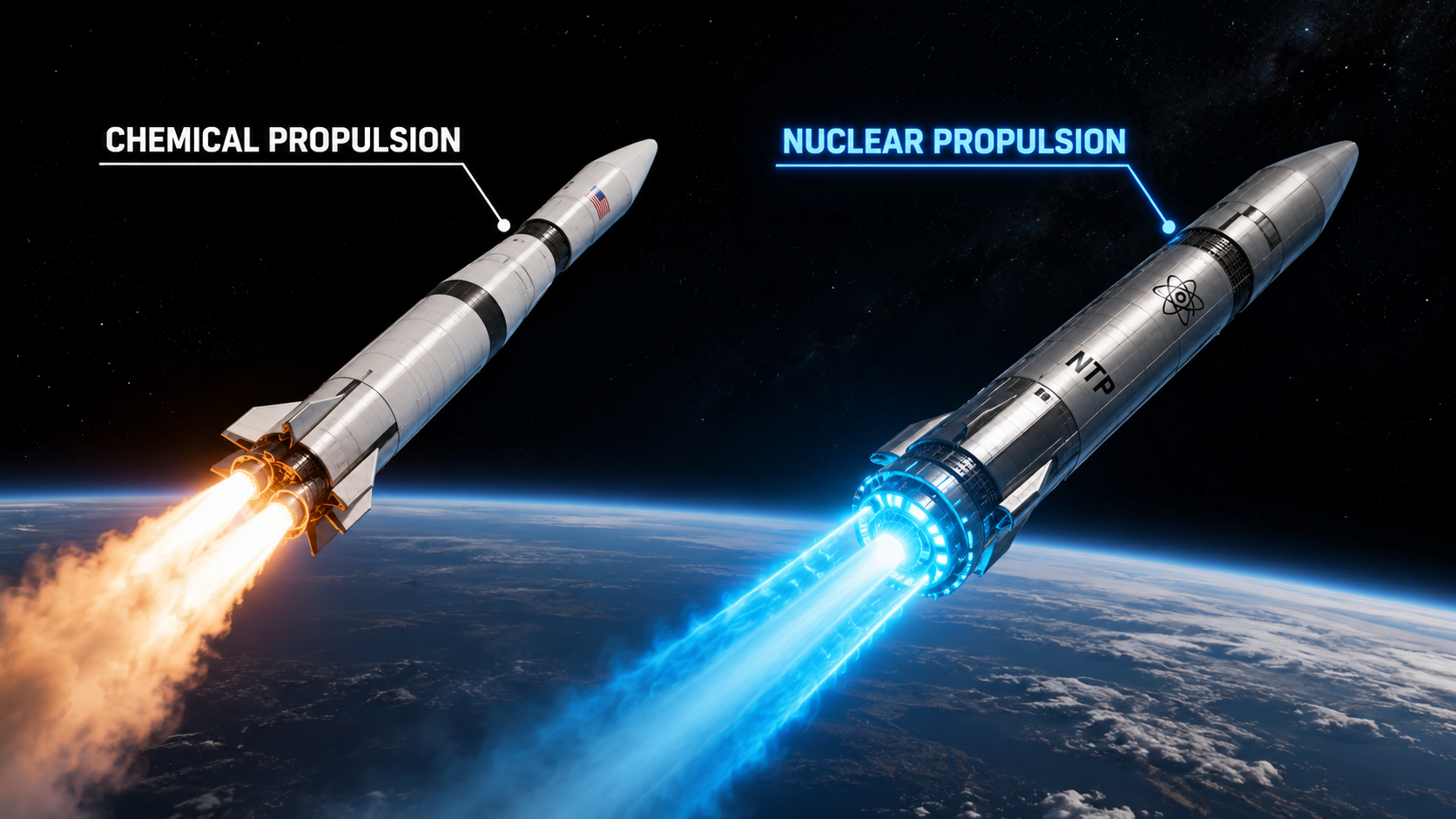
Why can’t we build a nuclear propulsion rocket today? Since we commenced space exploration with the launch of the first-ever rocket (the German V-2 ballistic missile) on June 20, 1944, to date, the world has been exploring space with chemical propulsion engines. Despite several advantages this old propulsion system offers, it still has numerous disadvantages. One of these disadvantages is its ability to reach a distant planet or cosmic object fast enough.
Hence, for decades now, scientists have been working on creating better propulsion systems that would enable us to reach distant worlds faster and accomplish more space mission goals in our lifetime. Nuclear Propulsion is one of the best propulsion systems scientists are working to use and replace chemical propulsion.
NASA has invested billions of dollars in the research and development of nuclear propulsion rockets that could reach Mars in only 45 days instead of the regular 8 months by chemical propulsion. So why are space agencies still slow in using nuclear propulsion to explore space? You are about to find out.
Why Space Agencies Are Still Stuck on Chemical Rockets
On March 16, 1926, American physicist Dr. Robert H. Goddard launched the world’s first successful flight of a liquid-fueled (chemical) rocket. It was a 10-foot rocket, powered by liquid oxygen and gasoline. After the launch, the rocket flew for 2.5 seconds, reaching a height of 41 feet and a distance of 184 feet.
However, it was not until after the Second World War that the world saw the need to begin the space race and begin launching rockets into space. Space agencies have spent decades launching missions with chemical propulsion. And despite knowing that nuclear propulsion is technically superior in several key areas, they keep going back to the same old liquid fuel engines.
You may be thinking that space agencies are just ignorant of trying new things. However, the delay in migrating from chemical propulsion to nuclear propulsion could be tied to a combination of politics, money, fear, and institutional habit that is very hard to break. Now, these are some of the reasons why space agencies are still slow with the development of nuclear propulsion.
The first reason is cost and development time
Nuclear propulsion systems, whether nuclear thermal or nuclear electric, require years of research, testing, and regulatory approval before a single engine can be certified for flight. Hence, any space agency willing to develop one must be ready to go through the necessary process.
On the other hand, Chemical rockets, for all their inefficiency, are a known quantity. Engineers don’t need complex engineering to understand them. In fact, manufacturers at different space agencies can easily build them from already existing space technologies since the supply chains already exist. However, starting over with a nuclear system means rebuilding expertise from scratch, and space agencies work on long budget cycles that rarely favor decade-long bets on unproven hardware.
Then there is the regulatory problem
Launching a nuclear reactor into space triggers layers of international oversight. At this point, we should note that the United Nations has guidelines on the use of nuclear power sources in outer space. The UN mandates that any mission carrying fissile material must pass safety reviews that can take years. No space agency wants to be the agency that loses a nuclear payload during a launch failure and scatters radioactive material over a populated area.
Even though that scenario is unlikely to happen, it is already enough reason to make program managers extremely cautious. The political cost of even a small accident would be enormous, and space agencies answer to governments that answer to voters.
Budget pressure adds another layer
For decades, chemical propulsion infrastructure has already existed. Launchpads, fueling systems, ground support equipment, and the workforce that runs all of it are already paid for. Converting to nuclear propulsion means either building new infrastructure or retrofitting the old, and that bill is rarely something any government agency can easily justify to a budget committee.
NASA’s nuclear thermal rocket research program, for example, has been started and stopped multiple times over the past fifty years whenever funding priorities shifted.
There is also a cultural element that does not get discussed enough
The engineers and mission planners who run these agencies grew up building and flying chemical rockets. Their models, their simulators, and their institutional knowledge are all built around that technology. Nuclear propulsion requires a different kind of expertise, one that sits at the intersection of aerospace engineering and nuclear physics, and that combination of skills is genuinely rare. Training a new generation takes time that program schedules rarely allow.
So, Can The Space Agency Ever Consider Launching a Nuclear Propulsion Rocket Anytime Soon?
Despite all of this, nuclear propulsion is not going away as a concept, and there are specific missions on the horizon where its advantages become too large to ignore.
A crewed mission to Mars is the clearest example. The main problem with sending humans to Mars is the time the crew spends in deep space, exposed to radiation and the physical effects of microgravity. A nuclear thermal rocket could cut transit time from roughly eight months down to three or four, which changes the risk calculation significantly.
NASA and DARPA have been jointly funding the development of a nuclear thermal engine called DRACO, to demonstrate the technology in the late 2020s. The expectation is that this eventually feeds into a crewed Mars architecture.
Missions to the outer planets are another area where nuclear propulsion makes chemical rockets look inadequate. Getting a probe to Neptune or Uranus with enough power to do serious science requires either nuclear electric propulsion or an extremely long mission timeline.
A nuclear electric system generates thrust continuously over months and years, allowing a spacecraft to build up far more velocity than any chemical burn can deliver while also powering high-bandwidth instruments and communications equipment.
Advantages of Nuclear Propulsion over Chemical Propulsion?
The core advantage of nuclear propulsion comes down to specific impulse, which is the measure of how efficiently a rocket uses its propellant. A chemical rocket tops out around 450 seconds of specific impulse. A nuclear thermal rocket can reach 900 seconds or more, meaning it gets twice the thrust per unit of fuel.
That difference, compounded over a long mission, means either carrying far less propellant or going much farther and faster. For missions beyond the asteroid belt, this is not a marginal improvement. It is a fundamental change in what is possible.
The agencies know that the physics is not in dispute. What is in dispute is whether the political will, the funding, and the risk tolerance will ever align long enough to actually fly one. History suggests that alignment happens slowly. But with Mars on everyone’s roadmap and the outer planets increasingly of scientific interest, the pressure to finally commit to nuclear propulsion is growing in ways it has not before.