

Why Orbital Data Centers and Space-Based Cloud Computing Could Become a Reality in the 2030s
What if the next generation of data centers were no longer built on Earth, but hundreds of kilometres above our planet, powered by sunlight and connected through high-speed laser communication systems? It sounds like something from a science-fiction movie, but some of the world’s biggest technology and space companies are already exploring ways to make it possible.
The concept is known as orbital data centers, and it could become one of the most interesting developments in the space industry during the 2030s.
To understand why companies are considering moving computing infrastructure into space, we first need to understand a growing problem on Earth.
Artificial intelligence is expanding rapidly. Every time someone generates an image, trains an AI model, processes enormous amounts of information, or uses a cloud-based application, powerful computers inside data centers perform the work.
These facilities require enormous amounts of electricity, cooling systems, water, land, and supporting infrastructure. As AI demand increases, technology companies are facing growing pressure to find additional power and suitable locations for new facilities.
Space could offer an unusual alternative.
How Would Data Centers in Space Actually Work?
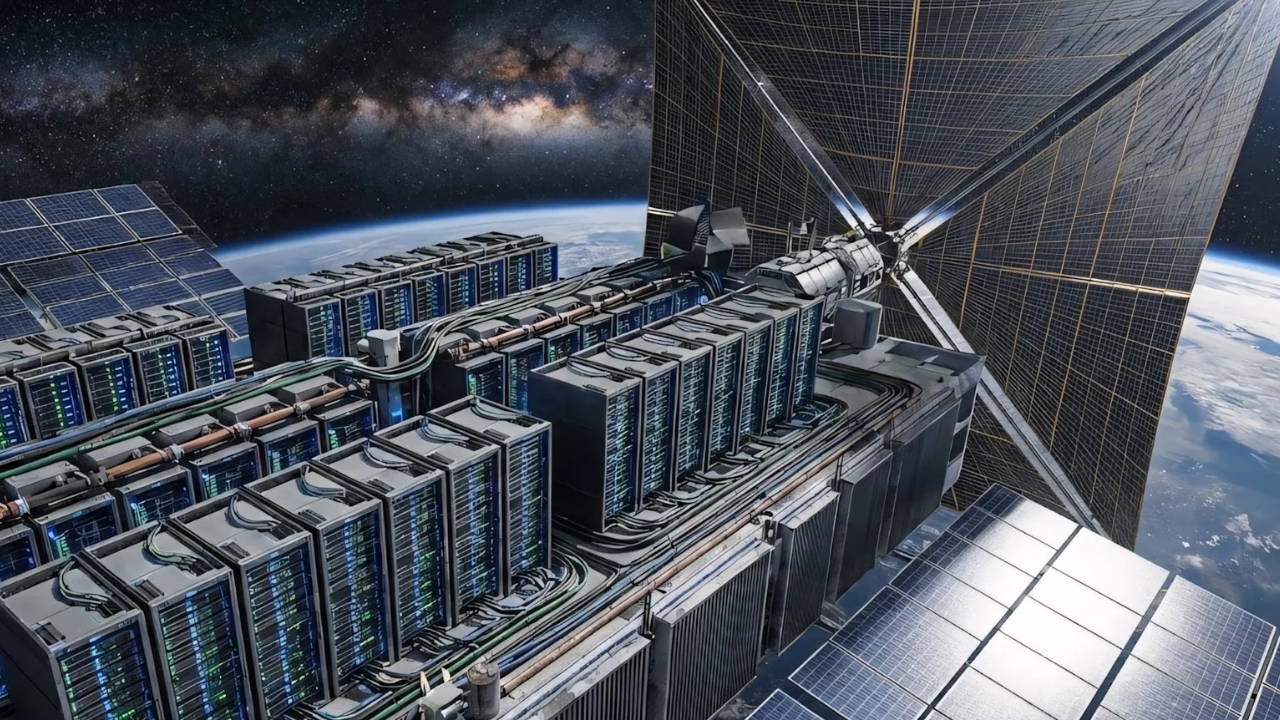
Instead of constructing a massive building filled with computer servers, companies could launch specialised satellites carrying powerful computer processors, storage systems, solar panels and communication equipment.
These satellites would operate in low Earth orbit, potentially hundreds of kilometres above the surface.
Once deployed, they would work together as a network of interconnected computers, forming something similar to a cloud computing system in space.
Solar panels would generate electricity to power the computers, while laser communication systems could transfer information between satellites and ground stations on Earth.
Rather than sending every piece of raw information back to Earth for processing, satellites could analyse data directly in orbit and transmit only the results.
For example, an Earth observation satellite collecting thousands of images of forests, oceans or agricultural land could send that information to an orbital data center. Artificial intelligence systems could analyse the images in space, identify changes and send useful results back to researchers.
This could reduce the amount of information that needs to travel between space and Earth.
Why Companies Are Looking Towards Space
One major attraction is solar energy.
Certain carefully selected orbits can provide satellites with sunlight for most or nearly all of their orbital journey. This could reduce dependence on large battery systems and provide a steady source of electricity.
Space also offers an opportunity to build computing infrastructure without competing for valuable land or depending directly on electricity grids.
Companies are particularly interested in the possibility of supporting energy-intensive artificial intelligence workloads.
Google’s Project Suncatcher is exploring how machine learning could operate using solar-powered satellites, with demonstration launches planned for 2027.
Meanwhile, companies such as Starcloud and other space technology startups are developing orbital computing concepts. China has also announced plans for a space-based computing network targeting 2030.
In April 2026, the US Government Accountability Office published an assessment of space-based data centers, confirming that several companies were already developing the technology.
The idea is therefore moving beyond theoretical discussions into engineering development and early demonstrations.
The Biggest Challenge: Cooling Computers in Space
However, there is one major problem that makes this technology much harder than it sounds.
Computers generate enormous amounts of heat, particularly when thousands of powerful processors are working together to train artificial intelligence models.
On Earth, data centers use fans, water systems, and industrial cooling equipment to remove this heat.
In space, things are different.
Although space is extremely cold, the vacuum surrounding a satellite does not provide an easy way to cool computer equipment. There is no surrounding air to carry heat away through normal convection.
Instead, orbital data centers would need large radiator systems that release excess heat into space through thermal radiation.
They would also need protection against cosmic radiation, which can damage electronic components and corrupt computer data.
These challenges will require significant engineering improvements before massive orbital computing facilities become practical.
Who Is Trying to Make It Happen?
Several major players are exploring this emerging industry.
- Google: Its Project Suncatcher is investigating how solar-powered satellites could support machine learning and artificial intelligence computing.
- Starcloud: The startup is developing space-based computing infrastructure designed to bring powerful AI processors into orbit.
- SpaceX: Its launch capabilities and proposed large satellite infrastructure could potentially support future orbital computing networks.
- China: The country has announced plans for a space-based computing network targeting 2030.
However, not everyone believes the technology will become commercially practical so quickly. In November 2026, Amazon Web Services CEO Matt Garman questioned whether orbital AI data centers could become economically practical within the next 10 to 20 years, pointing to launch costs, cooling, and radiation protection.
Could We Have Space-Based Cloud Computing by 2035?
The 2030s could be an important decade for this technology.
If reusable rockets continue reducing launch costs, solar power systems become more efficient, and engineers develop better cooling and radiation protection, companies could begin deploying larger networks of orbital computing satellites.
However, there are other problems to solve, including space debris, satellite maintenance, communication delays, and the high cost of replacing outdated computer hardware.
This is why orbital data centers are unlikely to replace traditional data centers completely.
Instead, the most realistic future could involve both systems working together. Earth-based facilities would continue handling everyday cloud services and applications that require immediate responses, while orbital facilities could process selected AI workloads, satellite observations, and enormous quantities of scientific data generated in space.
Imagine a future where some of the world’s AI computing infrastructure operates above our planet, powered directly by the Sun and connected through an enormous network of satellites.
The next major expansion of the internet might not happen only on Earth. It could extend into orbit.
And the 2030s might be when that transformation finally begins.